
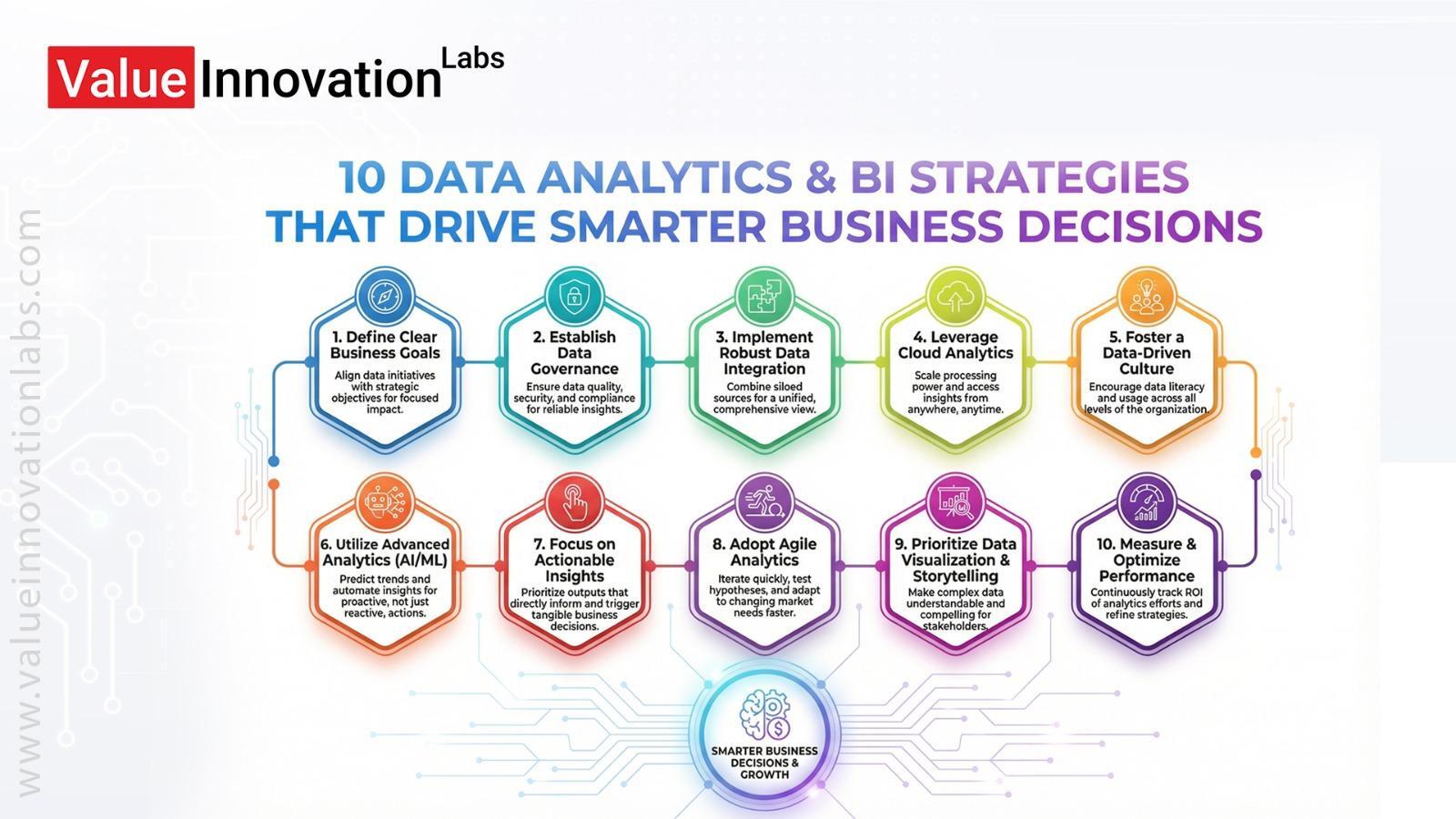
10 Data Analytics & BI Strategies That Drive Smarter Business Decisions
Data is no longer an option in today’s highly competitive corporate world; it’s a must-have. Indian businesses, from fast-growing startups in Bengaluru to long-established manufacturers in Pune, are learning that better data practices lead to better decisions.
But here’s the thing: just having data doesn’t mean you know how to use it well.
That’s where good Business Intelligence (BI) and Data Analytics tactics come in handy. Companies that use analytics to make decisions every day do better than their competitors in terms of revenue growth, operational efficiency, and customer happiness.
Value Innovation Labs helps businesses go beyond dashboards and make a meaningful, measurable difference.
This blog post talks about 10 tried-and-true Data Analytics and BI tactics that help Indian organizations make decisions that are smarter, faster, and more sure.
1.Set clear business goals before you start gathering data.
A lot of businesses buy analytics tools without knowing why they need them.
To begin, ask:
Are you aiming to keep your customers?
Make the supply chain work better?
Raise the rates of digital conversion?
Your analytics plan needs to be in line with your business goals that can be measured. Dashboards seem more like decorations than tools for making decisions without this clarity.
2. Create a Single Source of Truth
Indian companies often have trouble with data that is stuck in one place, such finance in one system, sales in another, and operations in still another.
A consolidated data warehouse or unified BI platform makes sure that
Data that is the same
Less duplication
Reporting that is accurate
When the same numbers are used in leadership meetings, decisions are made faster and with more confidence.
3. Pay attention to insights that are happening right now or very close to it.
For businesses in e-commerce, fintech, and logistics, delayed data means missed sales.
Dashboards that show data in real time let you:
Monitoring performance right now
Faster responsiveness to changes in the market
Solving problems before they happen
For example, if conversion rates go down during a campaign, marketing teams can make changes right away instead of waiting for weekly statistics.
4. Put data quality ahead of data quantity.
More data may not always lead to better insights.
Data that is clean, organized, and checked for accuracy makes sure:
Correctly predicting
KPIs that you can trust
Have faith in BI systems
Use automated validation checks and defined data governance policies to keep things honest.
5. Use predictive and prescriptive analytics
Descriptive analytics informs you what happened.
Predictive analytics shows you what could happen.
Prescriptive analytics tells you what you should do.
More and more Indian businesses are using AI-based forecasting models to:
Figure out how demand will change
Find out what causes churn
Make the most of your stock
Being able to see things in the past and the future gives you an edge over your competitors.
6. Make data available to everyone in the company
Analytics shouldn’t just be for IT or data teams.
Give power to:
Using campaign performance dashboards for marketing
HR with data on turnover
Operations that use efficiency metrics
Data-driven culture becomes a reality when teams can easily get role-specific insights.
7. Combine BI with operational workflows
Insights need to lead to action.
For instance:
CRM warnings that are set off by the possibility of churn
Inventory analytics that automatically reorganize items
Alerts for finding financial anomalies
Putting analytics right into workflows makes sure that choices are made on time.
8. Put money into training and data literacy
People, not technology, make a difference.
Teach leaders and middle managers how to:
Understand dashboards correctly
Ask inquiries that are more analytical
Don’t read metrics wrong
Companies that develop their own analytics skills don’t need to hire outside experts as much and can grow faster.
9. Instead of using vanity metrics, use KPI-driven dashboards.
Indian enterprises generally keep an eye on surface-level indicators like the number of downloads or social media impressions.
Instead, pay attention to KPIs that can be acted on:
Cost of Getting New Customers (CAC)
Value Over Time (LTV)
Rates of conversion
Time it takes to turn around operations
Dashboards that focus on KPIs help executives make better decisions.
10. Make sure the architecture is cloud-first and can grow.
As Indian businesses grow, the amount of data they have grows by a lot.
Take on:
Platforms for analytics that are in the cloud
Data pipelines that can grow
Business intelligence tools that are flexible
This makes sure that your analytics infrastructure grows together with your business instead of holding it back.
Why Indian Companies Need to Act Right Away
Over the next ten years, India’s digital economy is expected to rise quickly. Digital India and the growing use of SaaS solutions are making the competition even tougher.
Companies that only use their gut instinct could lag behind.
Companies who want to stay ahead of the curve are working with analytics firms that focus on innovation to:
Turn raw data into a strategic advantage
Make BI ecosystems that can grow
Make sure that analytics support long-term growth.
Value Innovation Labs and other groups assist firms go from reactive reporting to proactive intelligence.
The End
Business intelligence and data analytics are no longer just support functions; they are now important tools for growth.
The distinction between companies that do well and those that don’t is how well they:
Make sure metrics are in line with company goals
Keep your data high-quality and consistent.
Give teams useful information that they may use
Use predictive intelligence
These 10 tactics will help Indian firms not only make better choices, but also gain a long-term edge over their competitors.
In the future, companies who see data as a primary asset instead of a byproduct will do well.
Questions and Answers
1. What is the difference between Data Analytics and Business Intelligence?
Business Intelligence mostly employs reports and dashboards to look at how things have gone in the past. Data analytics uses more complex methods including predictive modeling, forecasting, and advanced statistical analysis to help make decisions in the future.
2. How can BI help small and medium-sized businesses in India?
Small and medium-sized businesses (SMEs) can utilize BI technologies to keep an eye on sales trends, manage their inventory better, cut costs, and better target customers, all without needing a lot of data staff.
3. How long does it take to put a Data Analytics plan into action?
The length of time it takes to implement something depends on how complicated it is. You can set up basic BI dashboards in a few weeks, but it may take several months to fully change your data and infrastructure for predictive analytics.
Data is no longer an option in today’s highly competitive corporate world; it’s a must-have. Indian businesses, from fast-growing startups…