
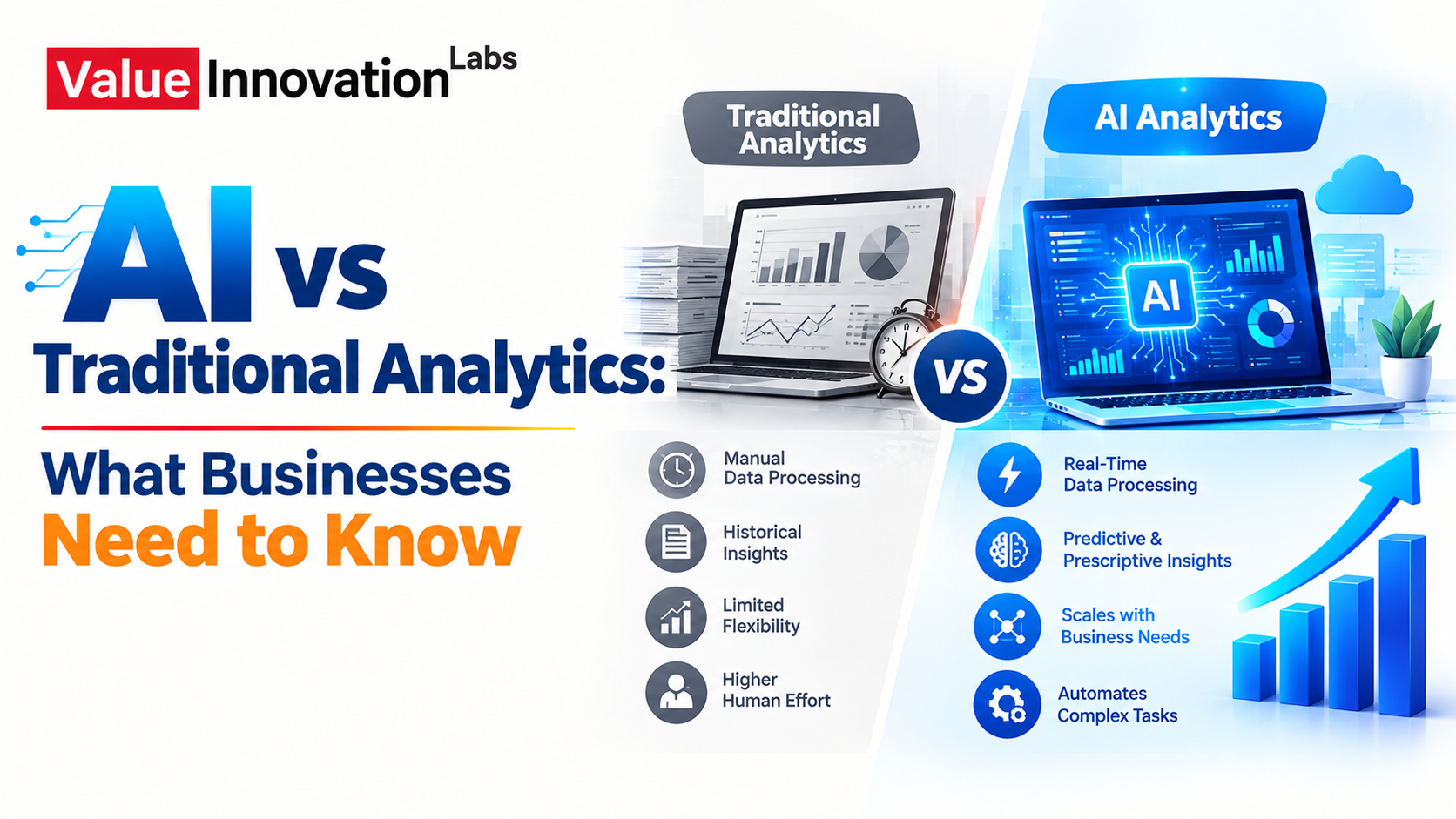
AI vs Traditional Analytics: What Businesses Need to Know
AI vs Traditional Analytics: What Businesses Need to Know
If you’ve ever sat through a meeting debating whether your company needs “AI analytics” or if your existing reporting tools are good enough, you’re not alone. As artificial intelligence becomes more common in business software, many leaders are left wondering how it actually differs from the traditional analytics they’ve relied on for years, and whether making the switch is really worth it.
The truth is, AI and traditional analytics aren’t necessarily rivals, they solve different problems, and understanding that difference is key to making smarter technology decisions. In this guide, you’ll learn exactly how AI vs traditional analytics compares, where each approach shines, and how to decide which one (or which combination) is right for your business.
What Is Traditional Analytics?
Traditional analytics refers to the standard methods businesses have used for years to analyze historical data, typically through spreadsheets, dashboards, and business intelligence (BI) tools. It focuses on describing what has already happened, using structured queries, manual reporting, and predefined metrics.
Common Traditional Analytics Tools
Examples include Excel-based reporting, SQL queries, and traditional BI platforms that generate charts and summaries based on historical data sets.
What Is AI-Powered Analytics?
AI-powered analytics uses machine learning and artificial intelligence to go beyond simple reporting. Rather than just showing what happened, it can identify patterns, predict future outcomes, and even recommend specific actions, often automatically and in real time.
How AI Analytics Tools Work
These systems continuously learn from new data, improving their predictions over time without requiring manual reprogramming for every new scenario.
AI vs Traditional Analytics: Key Differences
Understanding the core distinctions helps clarify when each approach adds the most value.
1. Descriptive vs Predictive Insights
Traditional analytics is primarily descriptive, answering “what happened?” AI-powered analytics is predictive and often prescriptive, answering “what’s likely to happen next?” and “what should we do about it?”
2. Speed of Analysis
Traditional analytics often requires manual data pulls and report generation, which can take hours or days. AI analytics tools can process large data sets and deliver insights in real time.
3. Handling Data Complexity
Traditional analytics works well with structured, well-organized data. AI-powered systems can also process unstructured data, such as customer reviews, images, or free-text feedback, extracting insights that traditional tools would miss entirely.
4. Scalability
Traditional analytics processes tend to require more manual effort as data volume grows. AI-driven analytics scales more efficiently, handling larger and more complex data sets without a proportional increase in manual work.
5. Level of Human Involvement
Traditional analytics relies heavily on analysts to interpret data and generate reports. AI-powered analytics automates much of this process, though human oversight remains important for context and validation.
Where Traditional Analytics Still Holds Strong
Despite the rise of AI, traditional analytics isn’t obsolete. It still plays an important role in many business scenarios.
Simple, Well-Defined Reporting Needs
For straightforward reporting, such as monthly sales summaries, traditional analytics tools remain efficient, reliable, and easy to understand.
Highly Regulated Industries
In some regulated sectors, traditional, transparent reporting methods are preferred because they’re easier to audit and explain compared to more complex AI models.
Smaller Data Sets
When data volume is limited, the added complexity of AI-powered analytics may not provide significant additional value over traditional methods.
Where AI-Powered Analytics Delivers More Value
AI-powered analytics tends to outperform traditional methods in more dynamic, data-heavy business environments.
Real-Time Decision-Making
Businesses that need to react quickly to market changes benefit significantly from AI’s ability to process and analyze data in real time.
Complex Pattern Recognition
AI excels at identifying subtle patterns across large, complex data sets, such as customer churn signals or fraud indicators, that traditional analytics might overlook.
Personalization at Scale
AI-powered analytics enables businesses to personalize marketing, recommendations, and customer experiences across thousands or millions of individual users, something traditional analytics struggles to do efficiently.
Forecasting and Predictive Planning
For demand forecasting, risk assessment, and strategic planning, AI-powered analytics generally provides more accurate, forward-looking insights than traditional descriptive reports.
Common Pain Points When Choosing Between AI and Traditional Analytics
Businesses often face a few recurring challenges when deciding how to move forward.
- Uncertainty about ROI, especially when AI tools require upfront investment
- Data quality concerns, since AI models require clean, reliable data to perform well
- Skill gaps, as teams may need training to interpret AI-generated insights effectively
- Over-reliance on either approach, when a combined strategy would serve the business better
How to Decide: AI, Traditional Analytics, or Both?
Most businesses don’t need to choose one approach exclusively. Instead, a hybrid strategy often delivers the best results.
Start With Your Business Goals
If you need accurate historical reporting, traditional analytics may be sufficient. If you need to predict trends or personalize customer experiences, AI-powered analytics becomes essential.
Evaluate Your Data Readiness
AI-powered analytics requires reasonably clean and accessible data. If your data is fragmented or inconsistent, addressing that first will improve results from either approach.
Consider a Phased Approach
Many businesses start with traditional analytics for core reporting, then gradually introduce AI-powered tools for more advanced forecasting and personalization as their data maturity improves.
Combine Both for Maximum Value
The most effective businesses often use traditional analytics for clear, auditable reporting, while layering AI-powered analytics on top for deeper insights and predictive capabilities.
Frequently Asked Questions
Is AI-powered analytics always better than traditional analytics? Not necessarily. AI-powered analytics excels at prediction, personalization, and handling large or unstructured data sets, while traditional analytics remains effective for simple, transparent reporting needs.
Can small businesses benefit from AI-powered analytics too? Yes. Many affordable AI analytics tools are now designed specifically for small and mid-sized businesses, making predictive insights accessible without requiring a large data science team.
Do businesses need to choose between AI and traditional analytics? No. Many successful businesses use a hybrid approach, relying on traditional analytics for standard reporting while using AI-powered analytics for forecasting, personalization, and deeper pattern recognition.
Conclusion
AI vs traditional analytics isn’t really a competition, it’s a matter of using the right tool for the right business need, with traditional methods still valuable for clear, auditable reporting and AI-powered analytics unlocking faster, more predictive, and more personalized insights as data complexity grows; if you’re looking to build a career in data and analytics, explore the latest job opportunities on Rojgar.com,
AI vs Traditional Analytics: What Businesses Need to Know If you’ve ever sat through a meeting debating whether your company…