
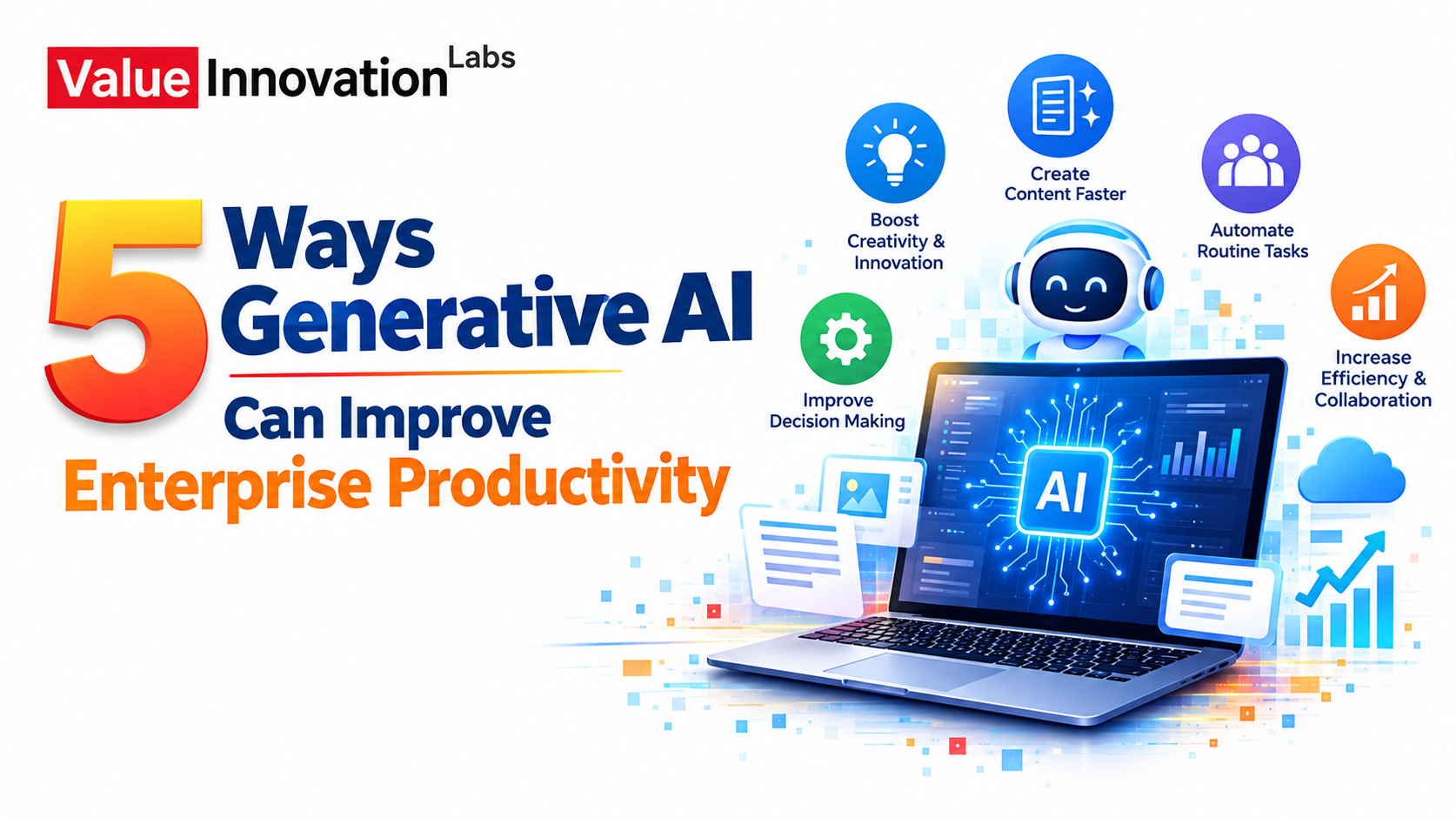
5 Ways Generative AI Can Improve Enterprise Productivity
5 Ways Generative AI Can Improve Enterprise Productivity
Every enterprise leader has felt it: teams stretched thin, repetitive tasks eating up valuable hours, and decisions taking longer than they should. Productivity has always been a challenge, but the tools available to solve it have changed dramatically. Generative AI, the same technology behind chatbots and content generators, is now being used inside enterprises to save time, reduce manual work, and help teams focus on what actually matters.
This isn’t about replacing employees. It’s about giving them better tools. In this article, you’ll learn five practical ways generative AI can improve enterprise productivity, along with real examples, common challenges, and how to get started without wasting time or budget on the wrong approach.
What Is Generative AI and Why Does It Matter for Productivity?
Generative AI refers to systems that can create new content — text, images, code, summaries, and more — based on patterns learned from large datasets. Unlike traditional software that follows fixed rules, generative AI can adapt to context, making it useful for a wide range of enterprise tasks.
The reason this matters for productivity is simple: much of the time lost in enterprises comes from repetitive, low-value work. Generative AI in enterprise productivity strategies helps eliminate exactly that kind of friction, freeing up employees for higher-impact work.
1. Automating Repetitive Administrative Tasks
One of the clearest ways generative AI improves enterprise productivity is by taking over repetitive administrative work.
Drafting Emails and Reports
Instead of spending 20 minutes writing a routine email or status report, employees can use generative AI to produce a solid first draft in seconds, then simply review and adjust it.
Meeting Summaries and Action Items
AI tools can now transcribe meetings and generate concise summaries with clear action items, saving hours each week that would otherwise go into manual note-taking.
Data Entry and Documentation
Generative AI can auto-fill forms, generate documentation from existing data, and reduce the manual effort typically required for compliance and record-keeping tasks.
2. Speeding Up Research and Decision-Making
Enterprises often lose time simply gathering information before a decision can even be made.
Summarizing Large Documents
Generative AI can condense lengthy reports, contracts, or research papers into short, digestible summaries, helping decision-makers grasp key points without reading every page.
Answering Internal Questions Instantly
AI-powered internal assistants can pull answers from company knowledge bases instantly, reducing the time employees spend searching for information or waiting on colleagues.
Supporting Data-Driven Decisions
By generating quick analyses and highlighting trends, generative AI helps leaders make informed decisions faster, without waiting for a full analyst report.
3. Enhancing Content Creation and Communication
Content creation is one of the most time-consuming tasks across marketing, sales, and internal communications.
Marketing and Sales Materials
Generative AI can quickly produce first drafts of blog posts, social media captions, and sales pitches, allowing teams to focus their time on strategy and refinement rather than starting from a blank page.
Internal Communication
HR and leadership teams can use generative AI to draft policy updates, newsletters, and announcements in a fraction of the time it would normally take.
Multilingual Support
For enterprises operating across regions, generative AI can help translate and localize content quickly, improving communication across diverse teams.
4. Improving Software Development Efficiency
Generative AI is having a measurable impact on how fast development teams can build and ship products.
Code Generation and Debugging
Developers use AI coding assistants to generate boilerplate code, suggest fixes, and identify bugs faster than manual review alone.
Automated Testing
AI tools can generate test cases automatically, helping quality assurance teams catch issues earlier in the development cycle.
Documentation for Developers
Generative AI can automatically create technical documentation from codebases, saving engineering teams significant time that would otherwise go into manual writing.
5. Personalizing Employee and Customer Experiences at Scale
Personalization used to require significant manual effort. Generative AI makes it scalable.
Tailored Training and Onboarding
AI can generate personalized onboarding materials and training content based on an employee’s role, speeding up ramp-up time for new hires.
Customer Support at Scale
Generative AI-powered chat tools can handle a large volume of customer queries with personalized responses, improving both speed and customer satisfaction.
Personalized Internal Recommendations
From suggesting relevant documents to recommending next steps in a workflow, generative AI helps employees work more efficiently without manual searching.
Common Challenges When Adopting Generative AI in the Enterprise
While the benefits are clear, enterprises should be aware of a few common pain points.
- Data privacy concerns, especially when using AI tools with sensitive company information
- Inconsistent output quality, which requires human review before final use
- Employee training gaps, since teams need guidance to use these tools effectively
- Integration with existing systems, which can take time and technical resources
Addressing these challenges early, rather than ignoring them, leads to smoother and more successful adoption.
Frequently Asked Questions
Can generative AI really replace employees to boost productivity? No. Generative AI is best used as a productivity assistant that handles repetitive or time-consuming tasks, while employees focus on judgment, strategy, and relationship-building that AI cannot replicate.
Is generative AI safe to use with sensitive enterprise data? It depends on the platform. Enterprises should choose secure, enterprise-grade AI tools with strong data privacy controls rather than free consumer tools for sensitive information.
How quickly can a business see productivity improvements from generative AI? Many teams see measurable time savings within the first few weeks of adoption, especially for tasks like drafting content, summarizing documents, and automating routine communication.
Conclusion
Generative AI is proving to be one of the most practical tools for boosting enterprise productivity, not by replacing people, but by removing the repetitive, time-consuming tasks that slow teams down and allowing employees to focus on higher-value work; if you’re looking to grow your career in this fast-evolving space, check out the latest AI and technology job listings on Rojgar.com, and for further reading, explore McKinsey’s insights on generative AI in the workplace and Harvard Business Review’s coverage of AI productivity trends.
5 Ways Generative AI Can Improve Enterprise Productivity Every enterprise leader has felt it: teams stretched thin, repetitive tasks eating…