
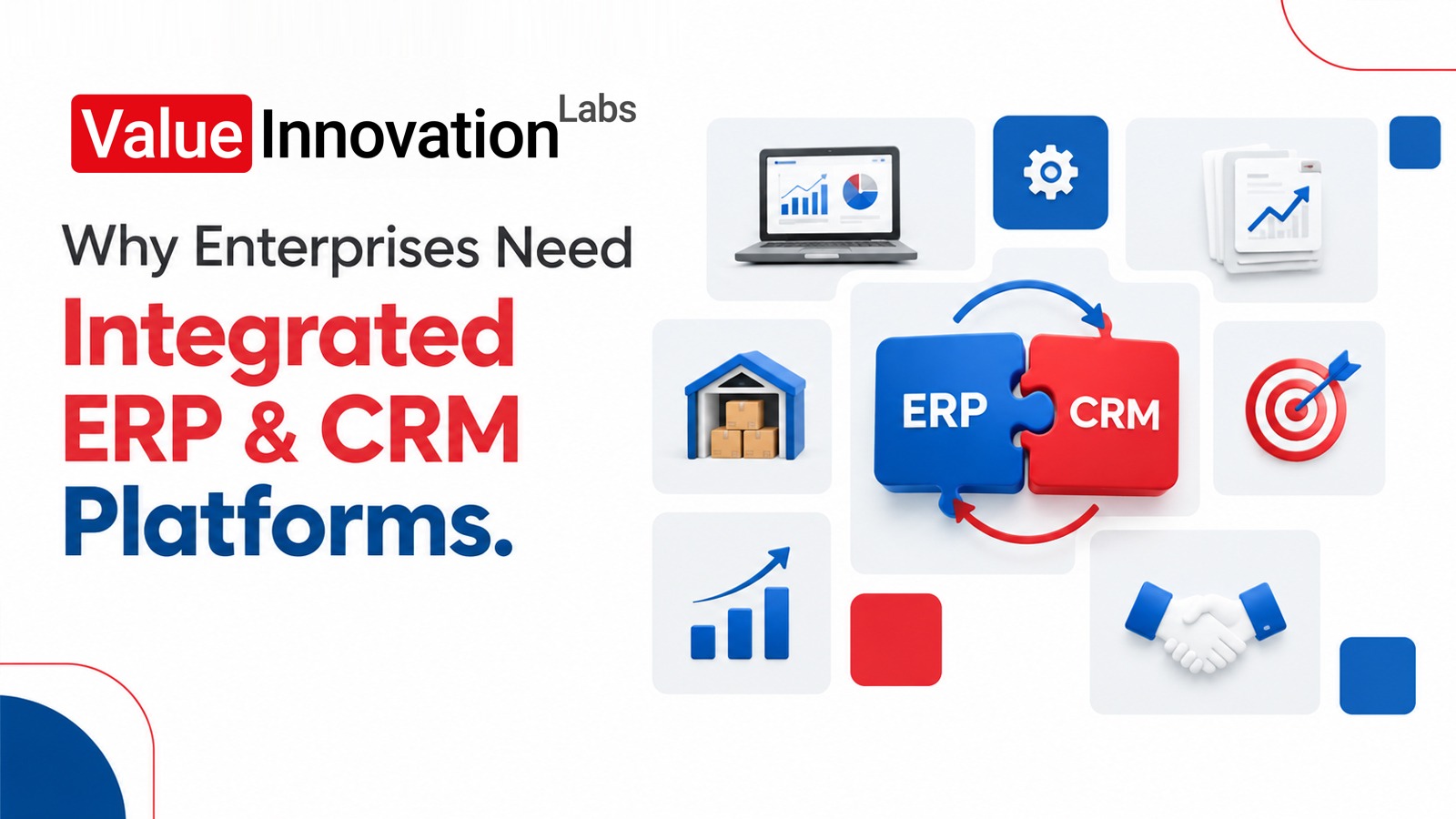
Why Enterprises Need Integrated ERP & CRM Platforms
Why Enterprises Need Integrated ERP & CRM Platforms
Picture this. A customer calls to ask about a delayed order. The sales rep opens the CRM and sees the deal marked “closed.” The warehouse team checks the ERP and sees the shipment stuck in processing. Nobody has the full picture, so the customer waits while people call each other.
This is the everyday cost of running ERP and CRM as separate islands. In this guide, you’ll learn why enterprises need integrated ERP and CRM platforms, what problems integration solves, and how to approach it without disrupting your operations.
What Are ERP and CRM Systems?
Quick answer: ERP (Enterprise Resource Planning) software manages internal operations such as finance, inventory, procurement, HR, and production. CRM (Customer Relationship Management) software manages everything related to customers, including leads, sales, support, and marketing.
Think of ERP as the engine room of the business and CRM as the front door. ERP knows what you have, what it costs, and what is being delivered. CRM knows who your customers are, what they want, and how they have interacted with you.
Each system is useful alone. The trouble starts when they don’t share information.
The Problem With Running ERP and CRM Separately
Data Silos Slow Everyone Down
When customer data lives in one system and order or billing data lives in another, teams spend their day exporting files, matching records, and fixing mismatches. Sales promises a delivery date without seeing real stock. Finance chases payments without knowing about a pending dispute. Every handoff creates delay.
Duplicate Entry Leads to Errors
If someone has to type the same customer details into two systems, mistakes are guaranteed. A wrong address, an outdated price, or a missed discount can turn into returns, refunds, and unhappy customers.
Leaders Make Decisions on Incomplete Data
Management reports built from disconnected systems often disagree with each other. When revenue in the CRM doesn’t match revenue in the ERP, leaders lose trust in the numbers and fall back on gut feeling.
Why Enterprises Need Integrated ERP & CRM Platforms
Integration connects the two systems so that data entered once is available wherever it is needed. Here is what that changes in practice.
1. A Single View of the Customer
With an integrated ERP and CRM platform, anyone who talks to a customer can see the complete history: quotes, orders, invoices, payments, delivery status, and support tickets. Support teams stop saying “let me check and call you back,” and customers notice the difference.
2. Faster Order-to-Cash Cycle
When a sales rep closes a deal in the CRM, the order can flow straight into the ERP for fulfillment and invoicing. No re-keying, no waiting for an email. Faster processing means products ship sooner and cash comes in earlier.
3. More Accurate Forecasting
Sales forecasts become far more reliable when they are linked with real inventory, production capacity, and past order data. Procurement can plan purchases based on the actual sales pipeline instead of guesses.
4. Better Cross-Team Collaboration
Sales, finance, operations, and support all work from the same facts. Disagreements about whose spreadsheet is correct disappear, and teams spend their energy solving problems instead of arguing about data.
5. Stronger Control and Compliance
A connected system makes it easier to keep audit trails, enforce approval rules, and manage access permissions. This matters for enterprises that deal with tax rules, industry regulations, or multiple locations.
Real-World Examples
These are typical scenarios rather than case studies of a named company, but they reflect what enterprises commonly experience.
- A distribution company: Sales reps used to quote from outdated stock sheets. After connecting CRM with ERP inventory, quotes reflected live stock, and order cancellations dropped noticeably.
- A manufacturing enterprise: Customer orders were passed to the plant through email. Integration sent confirmed orders directly to production planning, which cut the back-and-forth and shortened lead times.
- A services firm with multiple branches: Each branch kept its own customer list. A unified platform gave head office one customer database and clearer revenue reporting across locations.
In each case, the benefit came from information moving automatically instead of through people.
Signs Your Enterprise Needs Integration Now
- Teams re-enter the same data in two or more systems
- Sales cannot see inventory, pricing, or payment status
- Customers get different answers from different departments
- Month-end reports take days to reconcile
- You are growing, adding branches, products, or markets, and the current setup is strained
If several of these apply, integration is likely to pay back quickly.
How to Integrate ERP and CRM Without Disruption
Map Your Processes First
Before touching any software, write down how a lead becomes an order, and how an order becomes cash. Find the points where data is copied by hand. These are your first integration targets.
Choose the Right Approach
There are three common routes. You can use a suite where ERP and CRM come from the same vendor, connect existing tools through APIs and middleware, or build a custom integration layer around your own workflow. The right choice depends on your current systems, budget, and how unique your processes are.
Start Small and Expand
Begin with one high-impact flow, such as syncing customers and orders. Test it, fix issues, and then add invoicing, inventory, or support data. A phased rollout keeps daily operations running.
Clean Your Data Before Migrating
Duplicate customers, old records, and inconsistent formats will follow you into the new setup. A little cleanup upfront saves a lot of frustration later.
Train Your People
Even the best platform fails if teams don’t trust it. Involve users early, explain what changes for them, and keep support available after launch.
Common Mistakes to Avoid
- Treating integration as only an IT project. Business teams must own the process decisions.
- Trying to connect everything at once. This raises cost and risk.
- Ignoring security. Shared data needs clear access rules and encryption.
- Skipping measurement. Track metrics like order processing time and data errors so you can prove the results.
Frequently Asked Questions
What is an integrated ERP and CRM platform?
It is a setup where ERP and CRM systems share data automatically, so customer, order, inventory, and financial information stays consistent across all departments.
What are the main benefits of integrating ERP and CRM?
The main benefits are a single customer view, faster order processing, fewer manual errors, better forecasting, and more reliable reporting for leadership.
How long does ERP and CRM integration take?
It depends on complexity. A basic integration of customer and order data can take a few weeks, while a full enterprise-wide rollout may take several months when done in phases.
Conclusion
Enterprises need integrated ERP and CRM platforms because growth gets harder when customer data and operational data live apart. Connecting them gives teams one reliable source of truth and gives customers a faster, smoother experience. To keep learning, read our guides on how to build a career in enterprise software and the most in-demand IT skills this year, and for background on the topic, see this overview of enterprise resource planning on Wikipedia.
Why Enterprises Need Integrated ERP & CRM Platforms Picture this. A customer calls to ask about a delayed order. The…