
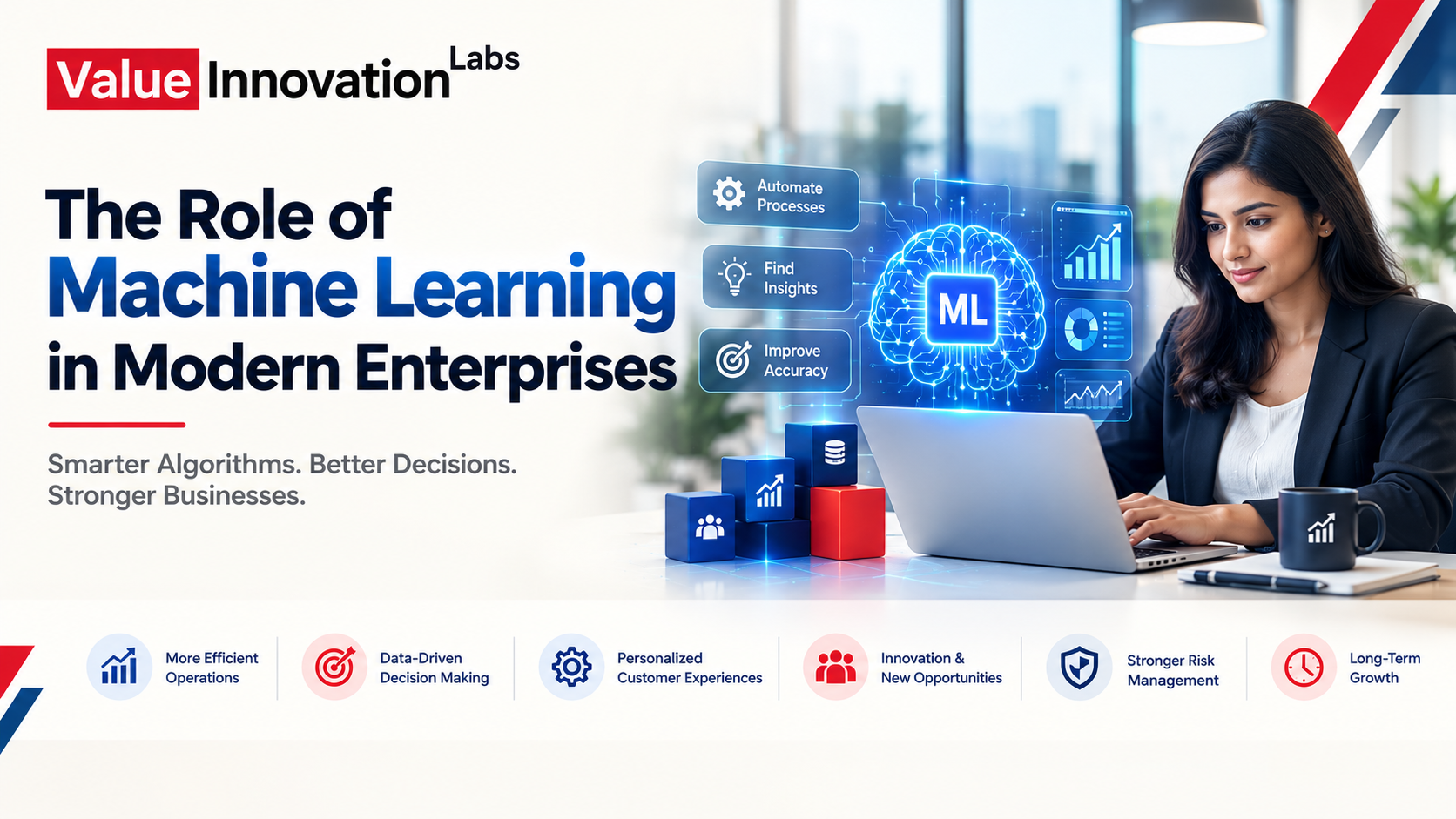
The Role of Machine Learning in Modern Enterprises
The Role of Machine Learning in Modern Enterprises
Walk into almost any large business today and machine learning is likely already at work behind the scenes, even if no one calls it out by name. It’s quietly powering fraud alerts at banks, product recommendations on retail sites, demand forecasts in warehouses, and spam filters in company inboxes. What used to be a niche technical specialty has become a core part of how modern enterprises operate and compete.
Yet many business leaders still aren’t entirely clear on what machine learning actually does differently from traditional software, or where it fits into their own operations. In this guide, you’ll learn what the role of machine learning in modern enterprises really looks like, where it’s delivering the most value, what challenges to expect, and how to start using it in a way that produces real results.
What Is Machine Learning, and Why Does It Matter for Enterprises?
Machine learning is a branch of artificial intelligence that allows systems to learn patterns from data and improve their performance over time, without being explicitly programmed for every scenario. Instead of following fixed rules written by a developer, a machine learning model is trained on historical data and uses what it learns to make predictions or decisions on new data.
How Machine Learning Differs From Traditional Software
Traditional software follows a set of predefined instructions: if X happens, do Y. Machine learning in enterprise systems works differently, identifying patterns in data and adjusting its outputs as it’s exposed to more information, which makes it especially useful for problems that are too complex or variable for fixed rules.
Key Roles Machine Learning Plays in Modern Enterprises
Machine learning isn’t a single tool, it’s applied across many different functions within a business. Here are the areas where its role is most significant.
1. Automating Repetitive and Data-Heavy Tasks
Machine learning models can process large volumes of data far faster than manual methods, automating tasks like invoice processing, document classification, and data entry validation.
2. Powering Predictive Analytics
One of the most valuable roles of machine learning in enterprises is enabling predictive analytics, using historical data to forecast future demand, customer behavior, or potential risks with far greater accuracy than manual estimates.
3. Enhancing Customer Experience
From personalized product recommendations to smarter chatbots, machine learning helps businesses tailor experiences to individual customers at a scale that would be impossible manually.
4. Strengthening Fraud Detection and Risk Management
Financial institutions rely heavily on machine learning to detect unusual transaction patterns in real time, helping prevent fraud before it causes significant damage.
5. Optimizing Supply Chain and Operations
Machine learning models help enterprises forecast demand, optimize delivery routes, and predict equipment maintenance needs, reducing costs and improving efficiency across operations.
6. Supporting Smarter Hiring and Workforce Planning
HR teams use machine learning to screen resumes more efficiently, predict staffing needs, and identify skill gaps, helping organizations plan their workforce more strategically.
7. Improving Marketing Performance
Machine learning helps marketing teams identify which campaigns are likely to perform best, segment audiences more precisely, and optimize ad spend based on real-time performance data.
Real-World Examples of Machine Learning in Enterprises
Seeing machine learning applied in practice helps clarify its impact.
- Retailers use machine learning to power product recommendation engines, increasing average order value through personalized suggestions.
- Banks apply machine learning models to flag potentially fraudulent transactions within seconds, protecting both the institution and its customers.
- Manufacturers use predictive maintenance models to identify equipment likely to fail soon, reducing costly unplanned downtime.
- Logistics companies use machine learning to optimize delivery routes in real time based on traffic, weather, and demand patterns.
Benefits of Machine Learning for Modern Enterprises
Understanding the tangible benefits helps clarify why adoption continues to grow.
Improved Accuracy in Decision-Making
Machine learning models can identify subtle patterns in large data sets that humans might miss, leading to more accurate forecasts and fewer costly mistakes.
Increased Operational Efficiency
By automating data-heavy and repetitive tasks, machine learning frees up employees to focus on higher-value strategic work.
Scalability Across the Business
Once developed, machine learning models can be applied across departments and regions without a proportional increase in staffing or manual effort.
Faster Response to Market Changes
Enterprises using machine learning can detect shifts in customer behavior or market conditions more quickly, allowing for faster, more informed responses.
Common Challenges When Adopting Machine Learning
Despite its benefits, enterprises often face a few recurring obstacles.
Data Quality and Availability
Machine learning models depend on large volumes of clean, relevant data. Poor data quality is one of the most common reasons projects fail to deliver expected results.
Lack of In-House Expertise
Building and maintaining machine learning models often requires specialized skills that many enterprises don’t yet have internally.
Integration With Legacy Systems
Connecting machine learning tools with older, existing enterprise systems can be technically complex and time-consuming.
Ensuring Ethical and Responsible Use
Enterprises must carefully monitor machine learning models, particularly in sensitive areas like hiring or lending, to avoid unintended bias or discrimination.
How Enterprises Can Successfully Adopt Machine Learning
A structured, step-by-step approach increases the likelihood of meaningful results.
Identify a Clear Business Problem First
Rather than adopting machine learning for its own sake, start by identifying a specific challenge, such as inaccurate demand forecasting or slow fraud detection, that the technology can genuinely help solve.
Invest in Data Infrastructure
Since machine learning depends heavily on data quality, enterprises should prioritize cleaning, organizing, and centralizing their data before scaling up any model.
Start With a Pilot Project
Testing machine learning on a smaller scale allows enterprises to measure real impact and build internal confidence before a wider rollout.
Combine Machine Learning With Human Oversight
Machine learning models should support human decision-making, not replace it entirely, particularly for high-stakes or sensitive business decisions.
Continuously Monitor and Improve Models
Machine learning models require ongoing monitoring to ensure they remain accurate as business conditions and data patterns evolve over time.
Frequently Asked Questions
Is machine learning only useful for large enterprises? No. While large enterprises often have more resources to invest, many affordable machine learning tools are now accessible to small and mid-sized businesses as well.
Do enterprises need a dedicated data science team to use machine learning? Not always. Many modern machine learning platforms offer user-friendly tools that allow business teams to apply predictive insights without deep technical expertise, though specialized talent helps for more complex use cases.
How is machine learning different from general artificial intelligence? Machine learning is a subset of artificial intelligence that focuses specifically on learning patterns from data to make predictions or decisions, while AI is a broader term covering various technologies, including machine learning, natural language processing, and more.
Conclusion
The role of machine learning in modern enterprises has grown far beyond a niche technical function, it now supports smarter decisions, stronger fraud protection, more efficient operations, and better customer experiences across nearly every industry, and businesses that invest in clean data and thoughtful implementation are the ones seeing the most lasting value; if you’re looking to build a career in this growing field, explore the latest AI and machine learning job opportunities on Rojgar.com,
The Role of Machine Learning in Modern Enterprises Walk into almost any large business today and machine learning is likely…