
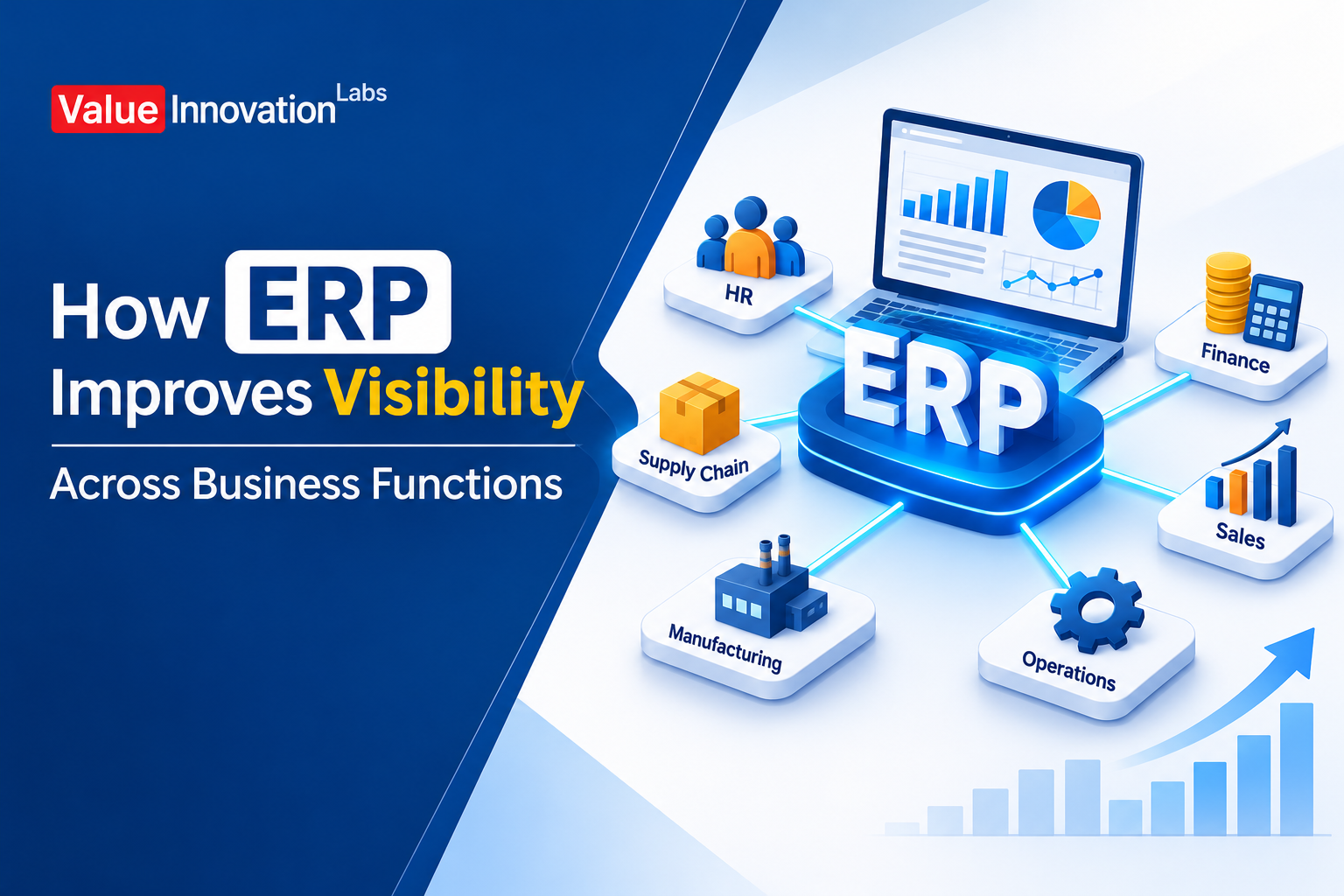
How ERP Improves Visibility Across Business Functions
How ERP Improves Visibility Across Business Functions
Ask three department heads how the business is doing, and you may get three different answers. Sales says the quarter is strong. Finance says cash is tight. Operations says half the orders are waiting on stock. Everyone is looking at their own numbers, and no one sees the whole picture.
That gap is exactly what ERP software is built to close. In this guide, you’ll learn how ERP improves visibility across business functions, what changes in each department, and how to get the most out of your system.
What Does “Visibility” Mean in a Business?
Quick answer: Business visibility means being able to see accurate, current information about every part of your operation, such as sales, stock, finances, and people, in one place and at the time you need it.
Good visibility lets you answer simple questions quickly. How many orders are pending? Which customers owe us money? Do we have enough material for next week’s production? When these answers take hours or days to find, decisions slow down and problems grow.
Why Visibility Breaks Down Without ERP
Information Lives in Separate Places
Sales keeps customer data in one tool, finance uses accounting software, the warehouse tracks stock in sheets, and HR has its own files. Each system is fine alone, but none of them shows how the pieces connect.
Reports Are Built by Hand
When someone must collect data from several sources and merge it, the report is slow to produce and out of date by the time it is read. It also carries the risk of copy-paste mistakes.
Teams Trust Different Numbers
If the sales report and the finance report disagree, meetings turn into arguments about whose data is right. That time would be better spent on solving problems.
How ERP Improves Visibility Across Business Functions
An ERP (Enterprise Resource Planning) system keeps data from every department in one shared database. When someone updates a record, everyone who needs it sees the change.
Finance: A Live View of Money
With ERP, finance sees invoices, payments, expenses, and balances as they happen. Month-end closing becomes faster because transactions are already recorded and linked. Managers can check cash flow, outstanding receivables, and budget use without waiting for a manual report.
Sales: Accurate Orders and Customer History
Sales teams can view stock levels, pricing, credit limits, and past orders while talking to a customer. Quotes become more reliable, and delivery promises match reality.
Inventory and Warehouse: Clear Stock Positions
ERP tracks stock by item, location, and movement. Teams see what is on hand, what is reserved, and what is on order. This reduces both stockouts and overstocking.
Procurement: Smarter Buying
Purchasing can see upcoming demand, supplier performance, and pending orders in one view. Orders can be planned based on real needs instead of guesswork.
Production: Better Planning and Tracking
Manufacturers can follow work orders, material use, and machine schedules. If a delay appears in one step, planners see the knock-on effect on later steps and customer deadlines.
HR: A Clear Picture of People and Costs
ERP can bring together employee records, attendance, payroll, and workforce costs. Leaders can see staffing levels and labor cost alongside production and sales figures.
Management: One Dashboard for the Whole Business
Leaders get dashboards that combine data from every function. They can spot trends, compare results, and drill down from a summary figure into the details behind it.
Key Benefits of Better ERP Visibility
- Faster decisions: Real-time data replaces delayed reports
- Fewer errors: Data is entered once and shared everywhere
- Better collaboration: Teams work from the same facts
- Early problem detection: Delays and shortages show up before they hurt customers
- Stronger control: Approvals and audit trails are easier to track
- Improved customer service: Staff can answer questions with confidence
Real-World Examples
These are typical scenarios rather than case studies of named companies, but they reflect what many businesses experience.
- A mid-sized manufacturer: Production, stock, and sales used separate files. After adopting ERP, planners saw confirmed orders and material availability together, which reduced last-minute rush jobs.
- A distribution business with several warehouses: Stock was tracked per location in separate sheets. ERP gave a combined view, so staff could fulfill orders from the nearest warehouse with available stock.
- A growing retail chain: Store managers had no view of head-office purchasing. With ERP, they could see incoming shipments and plan promotions accordingly.
In each case, the change came from people finally seeing the same information at the same time.
Signs Your Business Lacks Visibility
- Managers wait days for basic reports
- Departments argue over which numbers are correct
- Stock levels are often wrong
- Customer questions require calls between several teams
- Leaders feel they are making decisions in the dark
If these sound familiar, an ERP system, or a better use of your current one, could help.
How to Get More Visibility From Your ERP
Define What You Need to See
List the questions leaders ask most often, such as cash position, orders pending, or stock by location. Build dashboards around those questions first.
Keep Your Data Clean
ERP visibility is only as good as the data inside it. Remove duplicates, set clear naming rules, and make sure records are updated on time.
Make Sure Everyone Uses It
If some teams keep working in side spreadsheets, the shared picture becomes incomplete. Train staff and make the ERP the official source of truth.
Set Role-Based Access
Visibility doesn’t mean everyone sees everything. Give each person access to what they need, and protect sensitive financial and HR data.
Review and Improve Regularly
As your business changes, so should your reports. Review dashboards every few months and remove those nobody uses.
Common Mistakes to Avoid
- Expecting visibility without process discipline. Data must be entered correctly and on time.
- Creating too many reports. Focus on a few meaningful measures.
- Skipping training. Staff who don’t understand the system will find ways around it.
- Ignoring integration. Connect your ERP to e-commerce, CRM, and other tools so no data is left outside.
Frequently Asked Questions
How does ERP improve visibility in a business?
ERP stores data from all departments in one shared system, so teams see accurate, real-time information about sales, stock, finances, and operations without manual reports.
Which business functions benefit most from ERP visibility?
Finance, inventory, sales, procurement, and production usually gain the most, though HR and management also benefit from clearer data and dashboards.
Can small businesses benefit from ERP visibility?
Yes. Small businesses can use cloud-based or modular ERP systems to get a clear view of stock, sales, and cash without a large upfront investment.
Conclusion
ERP improves visibility across business functions by replacing scattered data with one reliable view that every team can trust. To keep learning, read our guides on how to build a career in ERP consulting and the most in-demand business software skills, and for background reading, see this overview of enterprise resource planning on Wikipedia.
How ERP Improves Visibility Across Business Functions Ask three department heads how the business is doing, and you may get…