
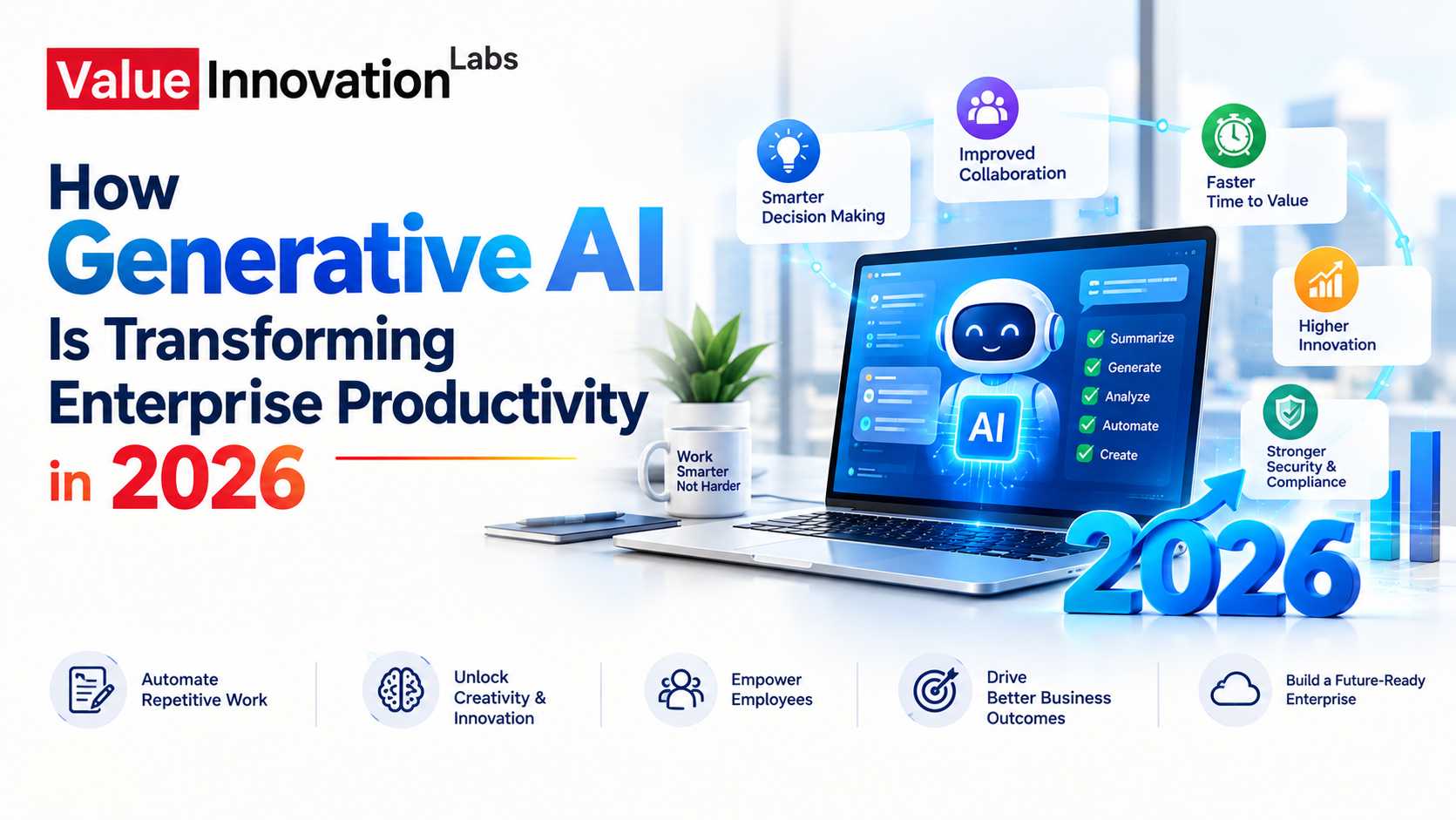
How Generative AI Is Transforming Enterprise Productivity in 2026
How Generative AI Is Transforming Enterprise Productivity in 2026
Not long ago, generative AI was something teams experimented with on the side, a chatbot for quick drafts or a novelty tool for brainstorming. In 2026, the picture looks very different. Generative AI has moved into the core of how enterprises operate, shaping how teams write, analyze, code, plan, and make decisions every single day.
But with so much attention on the technology, a fair question remains: is generative AI actually improving enterprise productivity, or is it just adding another layer of tools to manage? In this guide, you’ll learn where generative AI is making a real difference in 2026, what results businesses are seeing, which challenges still get in the way, and how to approach adoption in a way that delivers lasting value.
Where Generative AI Stands in the Enterprise in 2026
Generative AI refers to systems that create new content, including text, code, images, and summaries, based on patterns learned from large data sets. In 2026, these tools are no longer stand-alone experiments. They are increasingly built directly into the software employees already use, from email and documents to customer platforms and development environments.
From Simple Assistants to Task-Handling Agents
One of the biggest shifts this year is the growth of AI agents, systems that can carry out multi-step tasks with limited supervision, such as gathering information, drafting a report, and routing it for approval. This goes well beyond the single-prompt, single-answer tools that defined earlier years.
Why the Timing Matters
Enterprises that adopted early have had time to learn what works and what doesn’t. That experience is now shaping a more practical, results-focused approach to using generative AI for enterprise productivity, with less hype and more attention to measurable outcomes.
Key Ways Generative AI Is Improving Enterprise Productivity
Here are the areas where the impact is most visible across modern organizations.
1. Reducing Time Spent on Routine Work
Drafting emails, summarizing meetings, preparing status updates, and filling out documentation can consume a surprising share of the workweek. Generative AI handles the first draft of these tasks in seconds, leaving employees to review and refine rather than start from scratch.
2. Speeding Up Research and Knowledge Access
Employees often lose time hunting for information buried in documents, chats, and shared drives. AI-powered assistants connected to company knowledge bases can answer questions quickly and point to the source, cutting search time significantly.
3. Accelerating Software Development
Developers use AI coding assistants to generate boilerplate code, suggest fixes, write tests, and produce documentation. This shortens development cycles and allows engineering teams to spend more time on design and problem-solving.
4. Improving Customer Support Operations
Generative AI helps support teams by drafting replies, summarizing long ticket histories, and handling common questions automatically. Human agents can then focus on complex or sensitive cases that need empathy and judgment.
5. Supporting Faster, Better-Informed Decisions
Leaders can ask AI tools to summarize reports, compare scenarios, and highlight trends. This shortens the gap between having data and acting on it, which is often where productivity quietly slips away.
6. Personalizing Training and Onboarding
AI can generate tailored learning materials based on a person’s role and experience level, helping new hires become effective sooner and giving existing employees a faster way to build new skills.
Real-World Examples of Generative AI Boosting Productivity
Concrete examples make the benefits easier to picture.
- Marketing teams use generative AI to produce first drafts of campaign copy, product descriptions, and social posts, then spend their time on strategy and brand voice.
- Legal and compliance teams use it to summarize lengthy contracts and flag unusual clauses for human review, reducing hours of manual reading.
- Finance teams use it to draft variance explanations and summarize performance reports, which speeds up month-end reporting.
- HR teams use it to draft job descriptions, policy updates, and internal announcements more quickly and consistently.
The Measurable Benefits Businesses Are Seeing
When implemented thoughtfully, generative AI tends to deliver benefits that show up in day-to-day operations.
Time Savings Across Teams
Even modest time savings per employee add up quickly across a large organization, freeing up hours that can be redirected toward higher-value work.
More Consistent Quality
AI can help maintain consistent tone, formatting, and structure across documents and communications, which is especially useful in large, distributed teams.
Faster Turnaround on Projects
By speeding up drafting, research, and analysis, generative AI helps teams move from idea to delivery more quickly.
Greater Capacity Without Extra Headcount
Teams can handle a larger workload without proportionally increasing staff, which is particularly valuable for growing businesses.
Challenges Enterprises Still Face in 2026
Despite the progress, adoption is not without obstacles, and being honest about them leads to better planning.
Data Privacy and Security
Enterprises must be careful about what information is shared with AI tools. Choosing secure, enterprise-grade platforms with clear data controls is essential for protecting sensitive information.
Accuracy and Reliability
Generative AI can produce confident-sounding but incorrect answers. Human review remains important, especially for legal, financial, and customer-facing content.
Employee Adoption and Training
Tools only improve productivity when people actually use them well. Without training and clear guidance, adoption tends to stall or become inconsistent.
Measuring Real Return on Investment
Many organizations find it difficult to connect AI usage to concrete business outcomes. Setting clear metrics before rollout makes it much easier to see what is working.
How to Get Real Productivity Gains From Generative AI
A practical, step-by-step approach tends to work better than a broad, unfocused rollout.
Start With High-Friction Tasks
Look for repetitive, time-consuming work that slows teams down, such as reporting, documentation, or routine communication. These areas usually deliver the quickest wins.
Choose Secure, Well-Integrated Tools
Select tools that fit into your existing workflows and meet your organization’s security and compliance requirements.
Train Employees on Both Strengths and Limits
Teach teams what generative AI does well, where it can go wrong, and how to review its output carefully.
Keep Humans in the Loop
Use AI to assist, not to replace judgment. Final accountability for important decisions should always rest with people.
Track Results and Adjust
Measure time saved, quality improvements, and employee feedback, then refine your approach based on what the data shows.
Frequently Asked Questions
How is generative AI improving enterprise productivity in 2026? Generative AI improves enterprise productivity by automating routine writing and documentation, speeding up research, assisting developers, supporting customer service, and helping leaders reach decisions faster, all while employees focus on higher-value work.
Will generative AI replace enterprise employees? No. It is most effective as an assistant that handles repetitive tasks, while people provide judgment, creativity, and relationship-building that AI cannot replicate.
Is generative AI safe for sensitive business data? It can be, provided the enterprise uses secure, business-grade platforms with strong privacy controls and clear internal guidelines about what data can be shared.
Conclusion
In 2026, generative AI is no longer an experiment on the sidelines, it is a practical tool that helps enterprises cut down routine work, access knowledge faster, and make better decisions, provided it is introduced with clear goals, secure tools, and proper human oversight; if you want to build a career in this fast-growing field, explore the latest AI and technology openings on Rojgar.com, and for further reading, check out McKinsey’s research on generative AI and productivity and Harvard Business Review’s coverage of AI in the workplace.
How Generative AI Is Transforming Enterprise Productivity in 2026 Not long ago, generative AI was something teams experimented with on…